Manumation Method™: For Business Owners Who Are Tired of Being the System
I burned out. Not dramatically. Quietly. The business was working. I was exhausted. That's when I discovered: my brain wasn't broken. The business just wasn't designed for how I think.

Founder & Business Coach
Built After Burnout Revealed the Business Wasn't Broken. The Design Was.
I burned out.
Not in a dramatic, everything-is-on-fire way. In the quieter, more confusing way.
The business was still working. Revenue was steady. Clients were happy.
And I was exhausted.
Not because I wasn't capable. Not because I lacked discipline. But because the business only worked if I was constantly holding it together.
The Kind of Burnout Nobody Warns You About
For a long time, my business ran because I was the glue.
I remembered what no system remembered. I followed up when tools went silent. I connected dots no one else even knew existed.
From the outside, it looked like leadership. From the inside, it felt like carrying invisible weight.
The kind where every small break costs momentum. Where stepping away creates anxiety instead of relief. Where you're proud things don't fall apart, and resentful that they would if you stopped.
I told myself this was normal. That this was just the cost of building something real.
It turns out… a lot of smart business owners believe that lie.
If This Sounds Familiar, Read Slowly
Manumation exists for a very specific kind of person: even though it ends up helping a lot of business owners and leadership teams.
You might recognize yourself.
You think fast. You see patterns early. You make non-linear jumps that don't always translate cleanly to others.
You're good in conversations. Good at vision. Good at holding context.
But the business keeps pulling you back into:
- ▶️ Remembering
- ▶️ Reminding
- ▶️ Fixing handoffs
- ▶️ Catching things that "should've worked"
Not because your team is bad. Not because you're disorganized.
Because the business is quietly designed to rely on you.
If you have ADD, or simply a brain that doesn't move in tidy sequences, most traditional systems fight how you think instead of supporting it.
So you adapt. You compensate. And eventually, you burn out.
The Question That Changed Everything
Manumation didn't start as a framework.
It started with a question I couldn't ignore anymore:
"Why does this business need me so much just to function?"
Not to grow. To function.
Why did things slow the moment I stepped away? Why did progress depend on memory instead of design? Why did I keep feeling like the hero and the bottleneck at the same time?
That's when it clicked.
The pressure wasn't personal.
It was structural.
What Manumation Actually Is
Manumation isn't a productivity system.
It's not hustle culture dressed up with AI. And it's not about automating everything.
It's a way of building a business that respects how humans actually work: especially humans who don't think in straight lines.
At its core, Manumation is built around five pillars every business already has:
- 1. Lead Generation: being found without chasing
- 2. Lead Nurture: staying present without hovering
- 3. Sales & Conversion: removing decision friction
- 4. Operations & Fulfillment: delivering without firefighting
- 5. Brand Advocacy: growth without constant promotion
Every business has all five. Every business leaks in at least one.
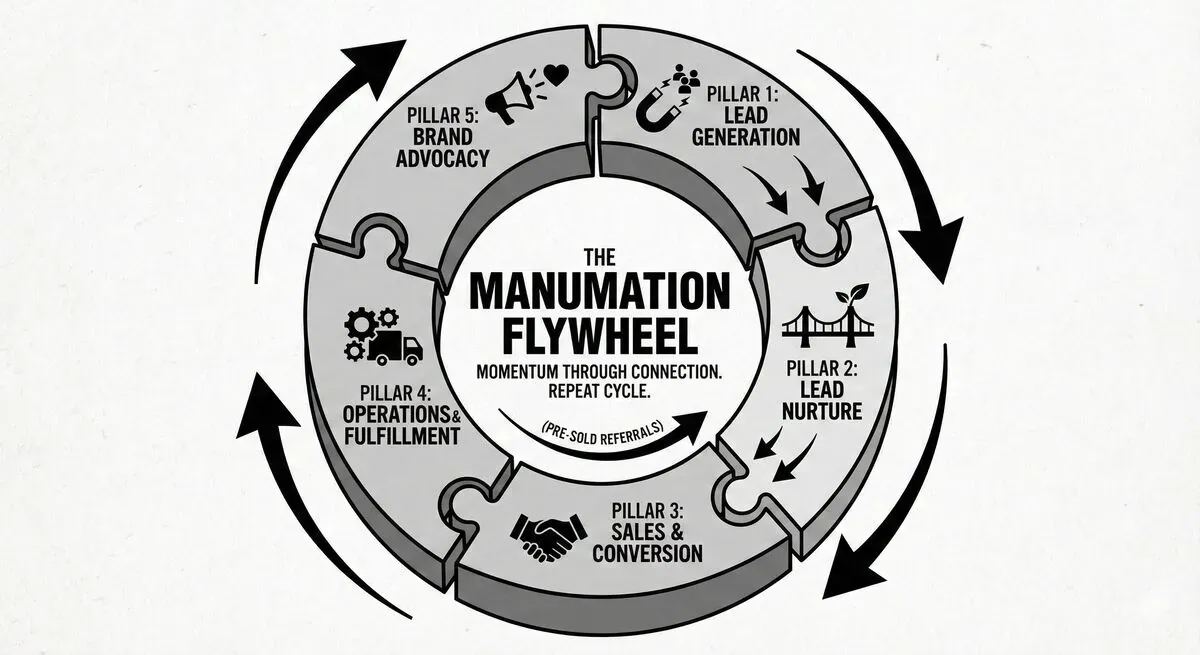
Most business owners don't know where the leak is: only that everything feels harder than it should.
Manumation is about identifying that pressure point and redesigning it so the business doesn't depend on heroics, memory, or constant intervention.
Why This Feels Different When You Read It
If you're used to business content telling you to:
- ▶️ Try harder
- ▶️ Be more disciplined
- ▶️ Focus better
- ▶️ Add another tool
…this will feel different.
Because Manumation starts from a different assumption:
Your brain isn't broken. Your business just wasn't designed for how you think.
You don't suck. You don't lack willpower. You don't need another framework duct-taped onto a broken system.
You don't have the method yet.
You don't have Manumation.
That realization alone is often the first real relief people feel in years.
Why I Wrote the Book
This post isn't here to teach you The Manumation Method™.
It's here to introduce it.
The book is where the real work lives:
- 🏛️ How this method actually formed
- 5️⃣ How the five pillars get rebuilt
- 👴 How AI and human judgment work together instead of fighting
- 🫣 How to stop being the invisible system holding everything up
I wrote it for business owners and leadership teams who are tired of carrying weight no one ever named.
If, as you read this, something in you keeps saying, "This is me," you're exactly who this was built for.
And the book is where it really begins.
Coming December 31st.
Ready to see where your pressure points are? Book a free intro call and let's map it out together.
Your next step
Ready to build a business that runs without you?
Take the free Bottleneck Audit to see where you stand, or book a no-pressure Discovery Call with Jeremy.
Straight answers
Frequently Asked Questions
What is The Manumation Method™?
The Manumation Method™ is a business design framework built around five pillars: Lead Generation, Lead Nurture, Sales & Conversion, Operations & Fulfillment, and Brand Advocacy. It helps founders identify where their business leaks energy and redesigns those pressure points so the business doesn't depend on heroics, memory, or constant intervention.
Who is The Manumation Method™ designed for?
Manumation is designed for business owners and leadership teams who think fast, see patterns early, and make non-linear jumps, especially those with ADD or brains that don't move in tidy sequences. It's for founders who are tired of being the invisible glue holding their business together.
What are the five pillars of The Manumation Method™?
The five pillars are: (1) Lead Generation: being found without chasing, (2) Lead Nurture: staying present without hovering, (3) Sales & Conversion: removing decision friction, (4) Operations & Fulfillment: delivering without firefighting, and (5) Brand Advocacy: growth without constant promotion.
How is Manumation different from regular business automation?
Regular automation tries to remove humans entirely. Manumation respects how humans actually work. It keeps humans in the loop for judgment, relationships, and creative decisions while systems own initiation, remembering, and routing. It's architecture-first, not software-first.
Why do business owners burn out even when their business is successful?
Many successful businesses are quietly designed to rely on the founder as the invisible system. The owner becomes the glue: remembering what systems forget, following up when tools go silent, connecting dots no one else sees. This creates structural pressure that leads to burnout even when revenue is steady.
When is The Manumation Method™ book being released?
The Manumation Method™ book is being released on December 31st. It covers how the method formed, how to rebuild the five pillars, how AI and human judgment work together, and how to stop being the invisible system in your business.
Can Manumation help if I have ADD or think non-linearly?
Yes. Manumation was specifically built for minds that don't move in tidy sequences. Traditional productivity systems fight how non-linear thinkers work. Manumation supports how you actually think by putting systems in charge of remembering, sequencing, and follow-up while you focus on vision, judgment, and relationships.
What does success look like with The Manumation Method™?
Success means the founder can step away for 14 days and leads still route, clients still feel handled, and revenue still moves. If that doesn't happen, the system failed, not the people. The goal is relief that holds, not temporary motivation.
- Manumation Method™
- Business Systems
- Founder Burnout
- Business Automation
- ADD Entrepreneur
- Delegation
- Leadership
- Small Business
This article is part of our
Operations and Fulfillment pillarHow to deliver the work without you being the bottleneck: SOPs, delegation, time, team, and the systems and automation behind them.
Keep reading